- Species
- Walleye
- Length
- 24.25 in
- Weight
- 5.00 lb
- Caught
- Day 2 · 09:14
- Position
- 46.8127 N 95.8460 W
- Photo timestamp agrees with the clock
- No impossible travel since the last fish
- Second fish within 40 m of the first
FishByte gives your tournament series its own branded app. Anglers register and pay in it, then measure, photograph and submit each fish from the boat, with or without a signal. Judges review what comes in from a dashboard, and the leaderboard updates as they work.
| 1 | R. Hale | 5 | 21.40 |
| 2 | M. Ortiz | 5 | 19.82 |
| 3 | T. Kwan | 4 | 18.15 |
| 4 | J. Renner | 5 | 17.63 |
| CUT TO 10 AFTER DAY 2 | |||
| 11 | D. Sorbo | 3 | 11.07 |
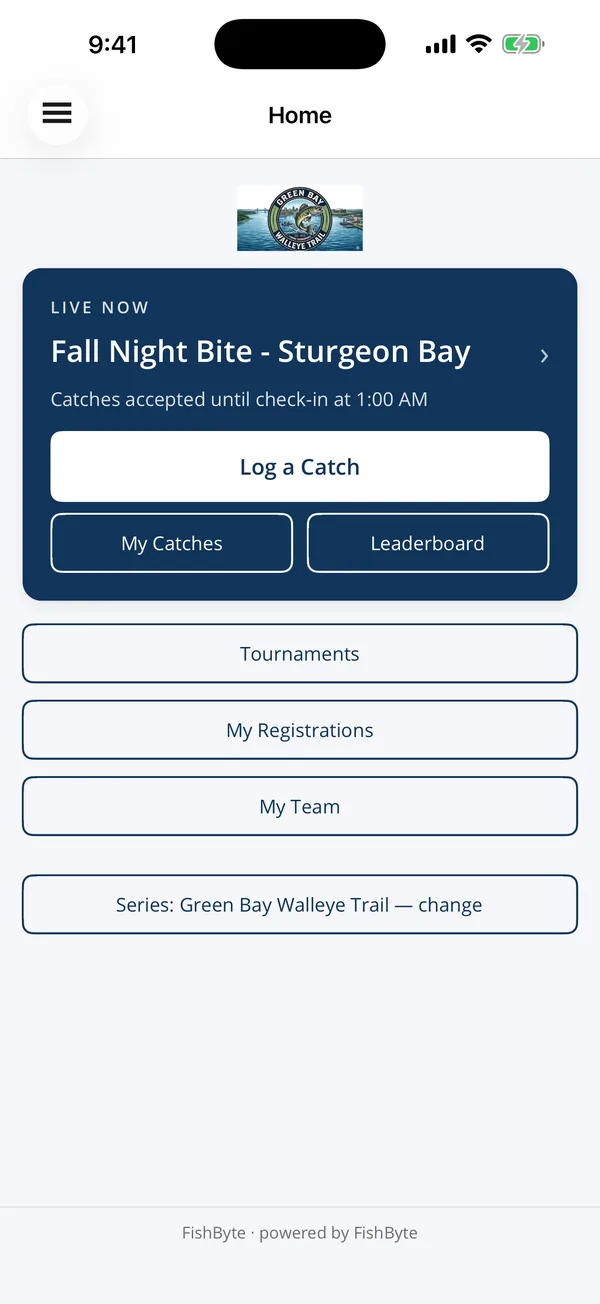
Ship your series to the App Store and Google Play under its own name, icon, and colors. FishByte runs underneath; anglers never see it.
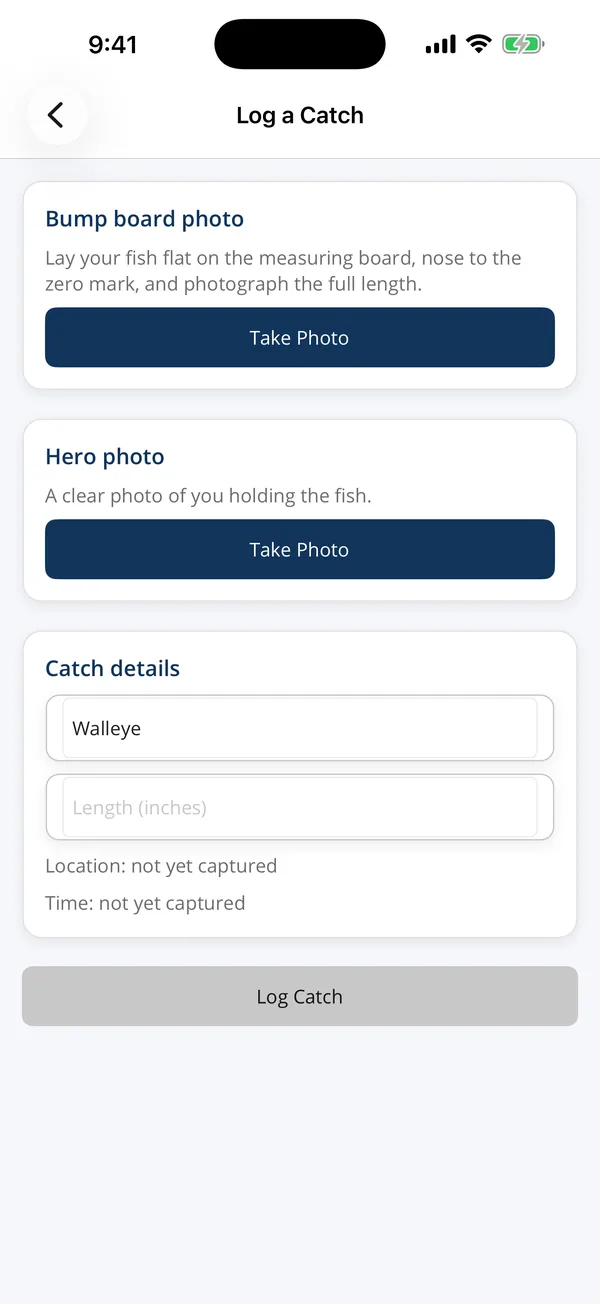
Two photos per fish: one on the bump board and one hero shot. Species, length and a GPS fix go with them, plus a release video if your rules ask for one.
Capture never touches the network. Catches queue on the device, compress as they are taken, and upload once a signal comes back. If the connection drops partway through, the next attempt picks up at the file it stopped on.
Photo EXIF, device location signals and the angler’s own earlier catches are cross-checked into an advisory score. Nothing is thrown out on that score alone. It tells a judge which submissions to look at first.
Judges work a live queue of pending catches with photo thumbnails, flags, and one-tap approve or reject. The page refreshes itself, so two judges never fight over a stale list.
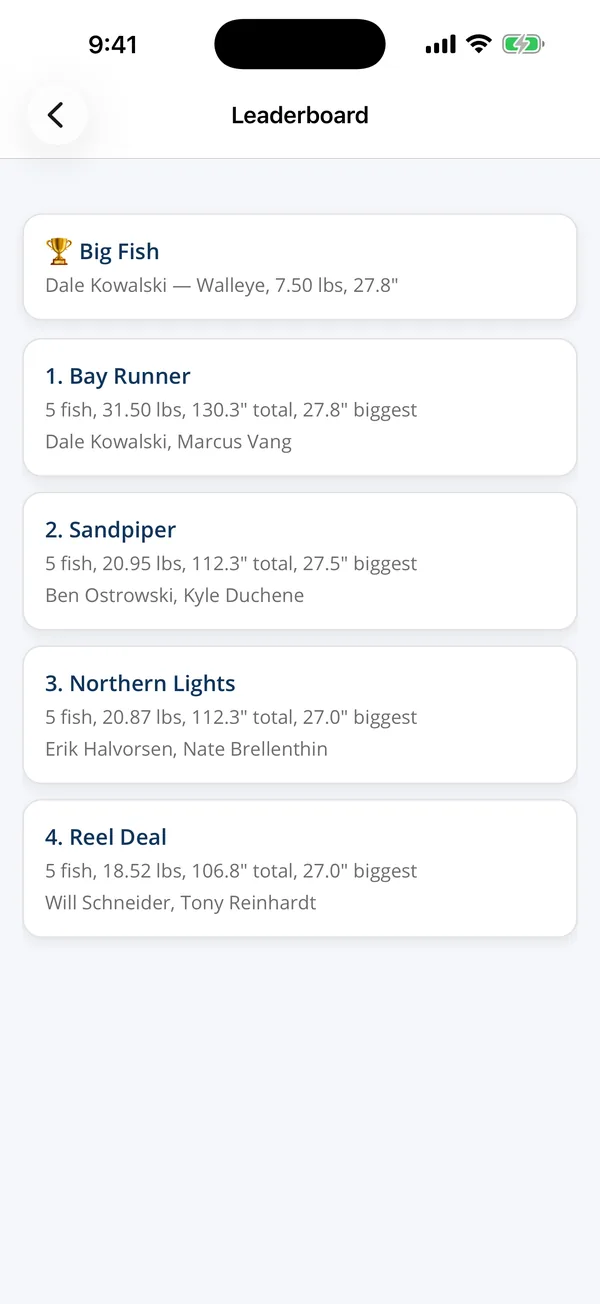
Standings recompute as catches are approved, on the board and in every angler’s pocket. Keep them hidden until you’re ready to reveal the field.
Draw the numbers the field blasts off on, at random rather than by who registered first. Draw again for late entries without moving a number already issued, and every boat is told its own.
A one-lane ramp cannot launch a hundred boats at once. Set boats per flight and minutes between them, and each flight goes out — and checks back in — that much later than the one before.
A catch decision, a director’s message to the field or to one angler, a boat number: each arrives as a push notification with an email copy behind it, and the dashboard reports how many of each landed.
Run a team series: anglers form a boat, partners join with a short code, and every rostered angler’s approved catches score for the team.
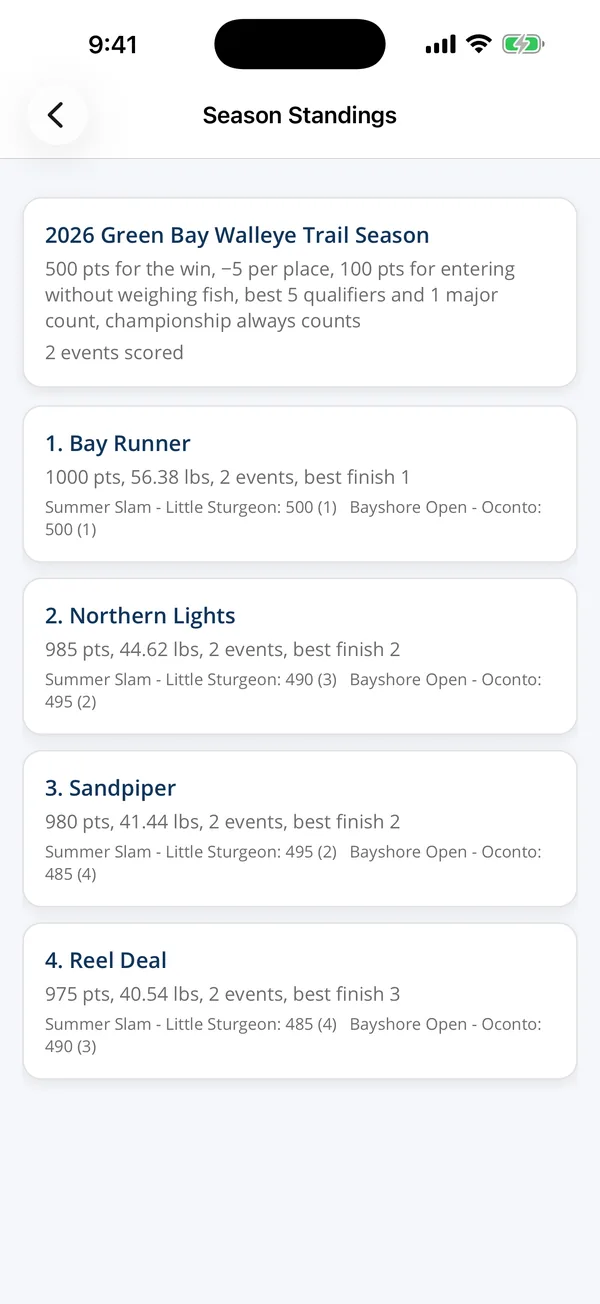
Group a year of tournaments into a points race, with qualifiers, majors, and a championship that all count for different amounts.
Collect entry fees in the app through Stripe, refund a withdrawal, and see exactly where the pool lands before you pay anyone.
A completed event produces the catch record a state DNR asks back — one row per date per species, counted off every approved catch rather than off the leaderboard.
Invite directors and judges by email, set what each one can do, and switch between series without a second login if you run more than one.

Screens from the shipping app, in the order an angler meets them: a fish measured in the boat, the board it moves, and the season it counts toward.


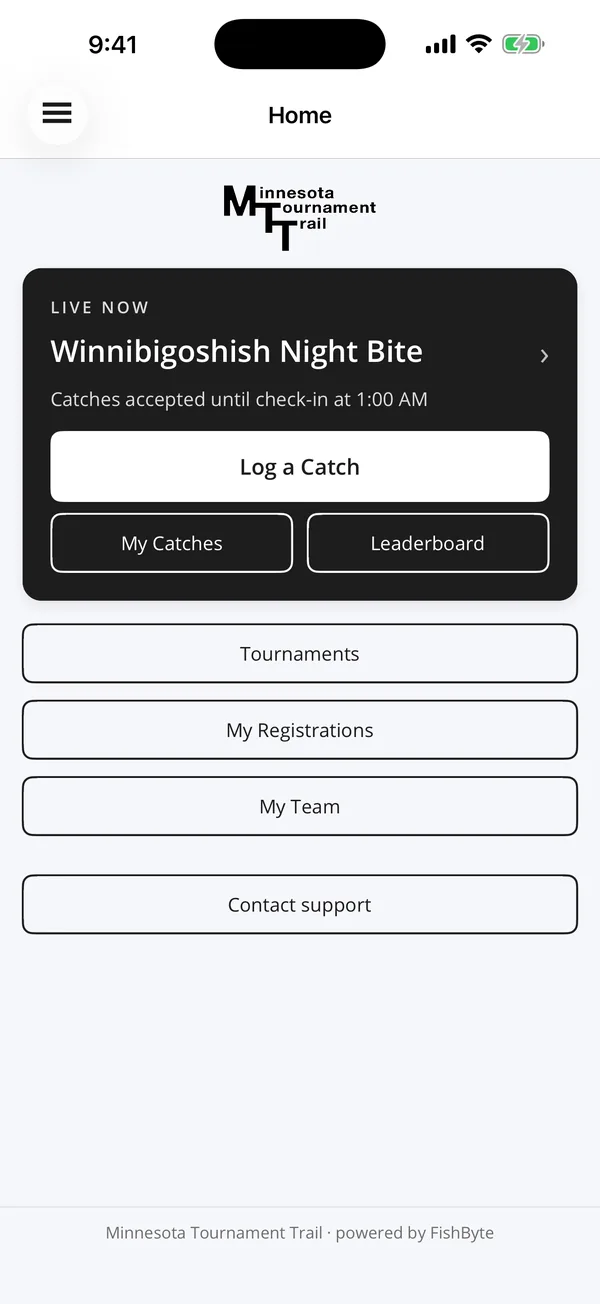
The same home screen, twice. On the left the FishByte app carrying a series’ logo and colors; on the right the same code built as a trail’s own app, under its own name and icon, where FishByte appears once, in the fine print at the bottom.


Catch-photo-release depends on the evidence holding up afterwards. FishByte records all of it at the moment the fish is caught, then runs its checks before the submission reaches a judge.
One published chart turns a measured length into a tournament weight, covering 14.00″ to 34.00″ in quarter-inch steps. The phone and the server run the same chart, so a fish still sitting in the offline queue already shows the weight it will score.
Rows shown are from the chart the platform ships with.
Before a single fish is measured, a director has to hand every boat a number, get the field off a ramp that fits three boats at a time, and make sure all of it reached the people standing on the dock.
Boat 1 gets first pick of water, so numbering by who registered first would hand a real advantage to whoever entered earliest — which is not what an entry fee buys. Directors print the sheet for the ramp; anglers read their own number off their own registration in the app.
| # | Boats | Out | In |
|---|---|---|---|
| 1 | 1–30 | 7:00 | 3:00 |
| 2 | 31–60 | 7:15 | 3:15 |
| 3 | 61–88 | 7:30 | 3:30 |
You set two numbers: boats per flight, and minutes between flights. How many flights that makes follows from the field, so 47 entries run two and 88 run three, and nobody goes back to the setting when late entries arrive. Both ends of the day move by the same interval, so every flight fishes the same hours and a boat that waited its turn is not charged for the wait.
The flight is not cosmetic. The app greys out the camera outside a boat’s own hours and the server holds a catch to the same ones, so boat 75 may log a fish at ten past three and boat 12 may not.
Push is the fast copy and email is the durable one — it is what an angler who never installed the app actually gets. Your dashboard says how many of each landed rather than just the word “sent”. A redraw tells only the boats whose number actually changed, so a director can press the button as often as the entries need it.
Lay out each competition day with its own start and end. Bags are per day and add up across the event, so a three-day five-fish tournament is three bags of five rather than the best five of the week.
Advance the top N after any day, and cut again the next. Anglers keep everything earned up to the cut, and the line is drawn from approved catches only.
Fish inside a protected length range are released unscored, the way a slot-limited walleye fishery already works.
Set the daily bag, and add a length bonus when your rules reward the longer fish over the fuller livewell.
Carve a slice of the pool out for the single biggest fish, tracked alongside the main standings.
Turn teams on for the whole org, or require them. Places are won by boats, so that is what the payout report pays.
Open registration, take entry fees, close the field when it fills, and refund an angler who withdraws.
Most trails need two things a single-event tool leaves out. Boats that stay together all year, and a points race that settles who won the season.
Join codes get read aloud across a dock and typed on a wet phone, so the alphabet leaves out every pair that gets misread there. No I or 1, no O or 0. Short boats also surface before blast-off rather than at the scales. The angler gets a warning, the director gets a list of who is short, and a fish from a boat that never filled its seats is turned away.
| 1 | R. Hale | 5 of 7 | 487 |
| 2 | M. Ortiz | 5 of 7 | 462 |
| 3 | T. Kwan | 5 of 6 | 441 |
Each event carries its own multiplier, so a two-day major can be worth double a qualifier without changing how many of either the season counts.
A permitted tournament owes its state a record of what it caught — Minnesota within 30 days of the last day fished, Wisconsin the same. A missed report is grounds for refusing the next permit, and directors have been assembling one by hand off a leaderboard that answers a different question.
| Date | Species | Anglers | Caught | Released | Measured | Inches |
|---|---|---|---|---|---|---|
| Jun 13 | Walleye | 68 | 91 | 91 | 91 | 2,041.75 |
| Jun 13 | Northern Pike | 68 | 12 | 12 | 12 | 331.50 |
| Jun 14 | Walleye | 68 | 84 | 84 | 84 | 1,902.25 |
A fisheries manager is asking how many fish came out of the lake and went back in. So the report counts every approved catch, including the sixth fish of a five-fish bag and a fish inside a protected slot. Both score zero on the board, and both were demonstrably caught.
The inches are measured inches, never bonus inches. A length bonus is your trail’s own invention, and reporting it would overstate every fish over the threshold to the person reading the form.
It waits for the event to be marked complete for the same reason the payout report does: numbers that moved every time a judge approved another catch would be worse than useless to the director holding the pen. Two things the page tells you rather than hides — mortality is not modeled, so every fish reads as released and you correct by hand if you lost one, and prize value is the payout pool, so sponsor and non-cash prizes are not in it.
FishByte handles the software side: registrations, the boat number draw, catch verification, judging, scoring, the money, and the report the state wants afterwards. That leaves your day for running the event. Your series keeps its own name, colors and app, from the store listing through to the leaderboard.
Set the split yourself. The payout report shows the collected pool, your organization's share, and every place it pays before you send a cent.
Create your organization and set up your first event today — anglers enter and submit catches through the FishByte app. Want it as your own branded app instead? That part we do with you.